2021 Syndicate Battlegrounds

Luke Espe • August 12, 2021
A black and white logo for syndicate battlegrounds

EVENT GUIDE


Saturday, September 18th
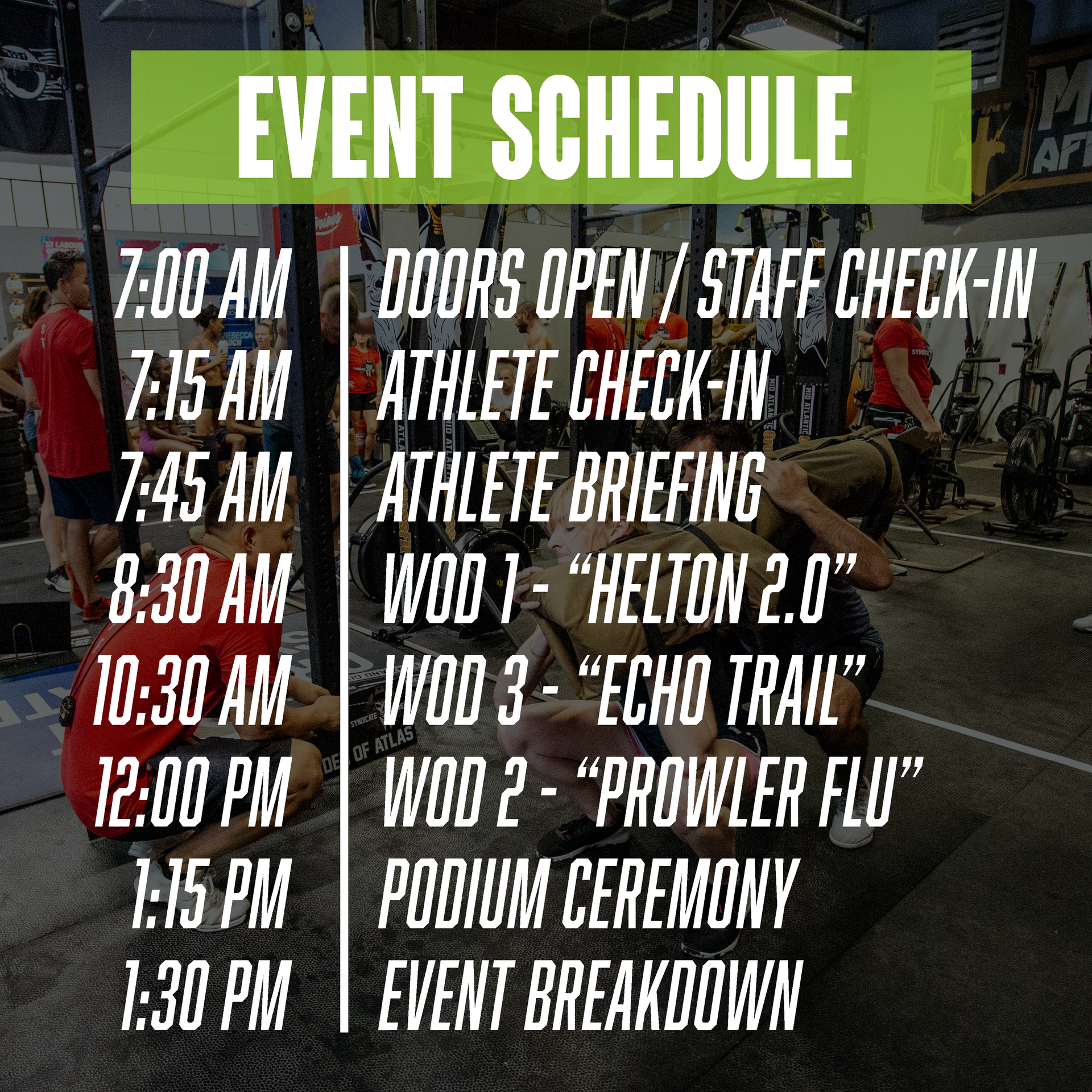
An event schedule for a gym with a podium ceremony

The Syndicate Battlegrounds, a two two person team competition will be held on Saturday, September 18th at 12 Labours CrossFit Columbia. The workout stages will be comprised of indoor and outdoor events.

There will be no olympic lifts or high skill gymnastics movements, instead grunt work style workouts will take place. The only prerequisite is hard work. 

It will be a premier fitness competition for the community. Athletes from affiliates in the greater Baltimore/Columbia area will have a chance to compete in a partner format. We will have multiple divisions and make sure that all athletes have the ability to compete.

For future announcements, please follow @thesyndicateseries on Instagram.
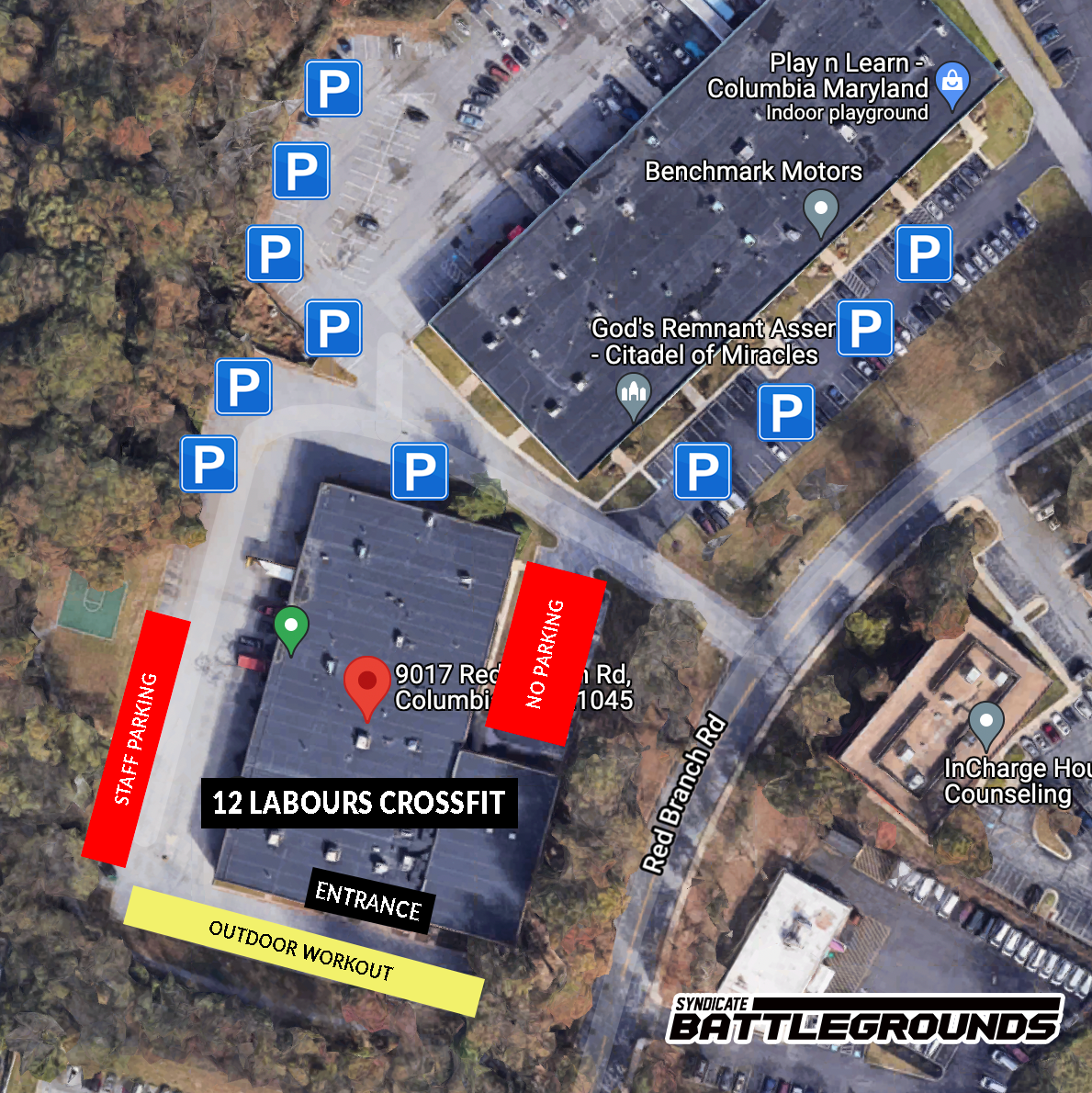
An aerial view of the 12 labours crossfit

Venue

12 Labours CrossFit Columbia, 9017 Red Branch Road Suite A, Columbia, MD 21045

⁣⁣ Divisions  (Teams of 2):⁣⁣
Male/Male Pair⁣⁣
Female/Female Pair⁣⁣
Male/Female Pair ⁣

No Refunds. Substitutions Only.

Questions or Concerns

For any questions, please email wilson@the12labours.com
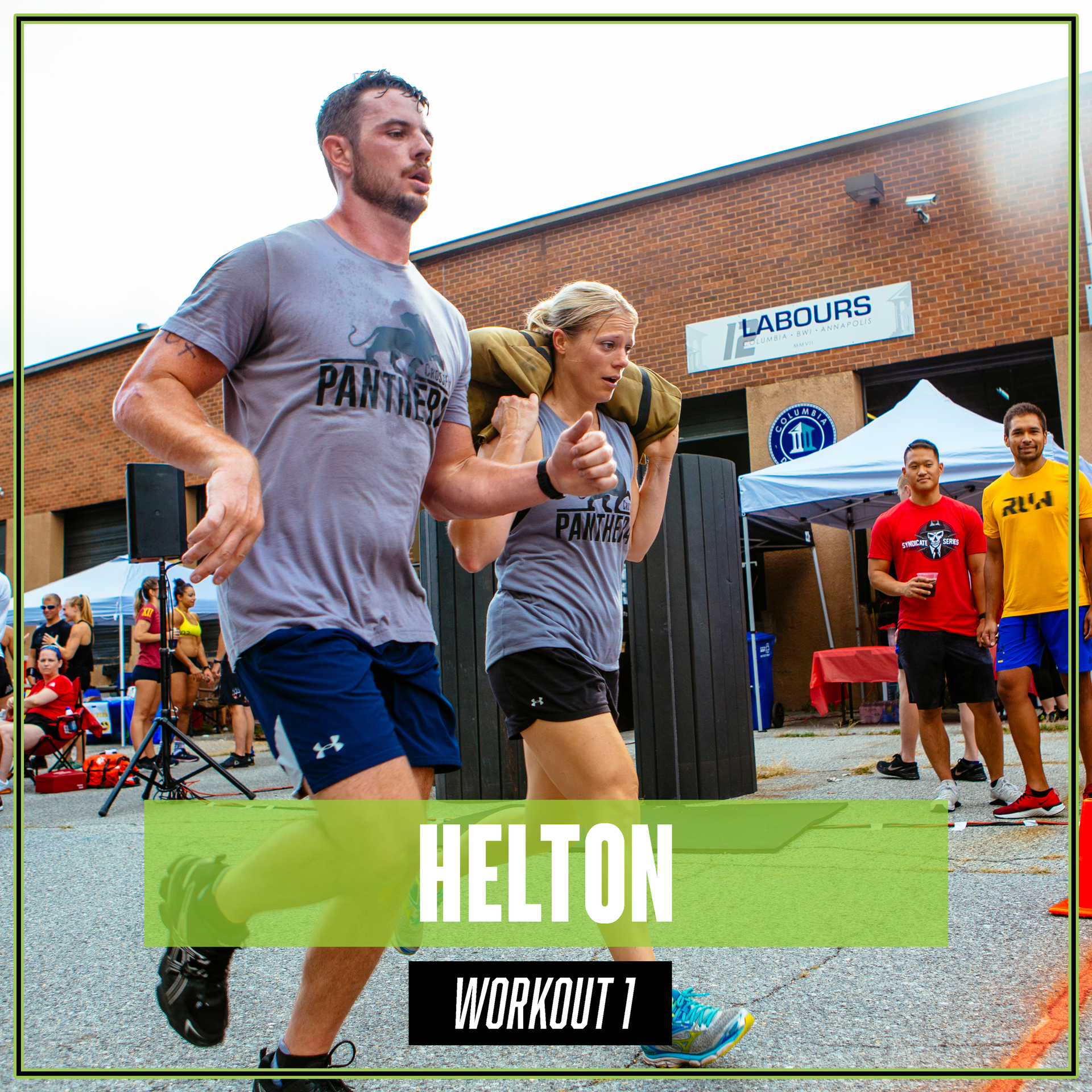

A man and a woman are running with a bag on their shoulders.

WOD 1 - “Helton 2.0”

3 rounds for time:

400m Synchro Run 

30 Dball to Shoulder 

20 Synchro Burpees to Plate 

* Dball - 1 person working at a time*

Time Cap: 20 minutes

Male: 100lbs Dball

Female: 70lbs Dball


Score

The score is time.


Flow

At the call of “3,2,1...Go!”, both athletes will begin a 400 meter run together on the designated route. Once BOTH athletes have returned from the 400m run, they may begin working on accumulating 30 Dball to Shoulder reps, with only 1 partner touching the DBall at a time. Upon completion of 30 repetitions of Dball to Shoulder, both athletes will complete 20 Synchronized Burpees to Plate. Once both athletes have completed 20 Synchronized Burpees to Plate, this signals the completion of 1 round. Athletes will complete 2 more rounds of this triplet in the same order for 3 total rounds. This workout is for time and scoring for this workout is the time it takes the pairing to complete all three rounds. 

Movement Standards

400m Synchro Run

This is a partner 400m run on the designated route. Partners may run at their own pace or speed, but what makes this a “synchro” run is that the both athletes MUST begin and finish the run together.

DBall to Shoulder

The repetition begins with the Dball on the ground and is completed on the top of the athlete’s shoulder with the athlete’s knees and hips at full extension. Only one athlete may work at a time accumulating repetitions and cannot receive physical assistance from their partner to complete the repetitions. For mixed gender teams, male athletes must accumulate reps at their prescribed DBall weight (100#) and vice versa for the female athlete (70#). The athlete not completing work must wait for the Dball to rest on the ground by their partner before starting their movement. Any reps performed with the incorrect DBall weight will be considered no-reps and will not count towards the work requirement. 

Synchro Burpees to Plate

This is a burpee to a 45# plate. Burpee standards begin with the athlete’s chest and thighs touching the ground (“prone position”). Either a step back or a jump back to achieve the prone position is acceptable. Either a step up or a jump up from the prone position is acceptable. Both feet must leave the ground at the same time (“two-foot take-off”) to jump to the plate. Once both feet have landed on the plate, a jump down or step down from the plate is acceptable. Synchro for this movement occurs when both athletes are clearly in the prone position. The repetition is completed when both athletes have completed the two-foot take-off and both feet have touched the top of the plate. The next rep cannot begin until both athletes have synchronized in the prone position. Lack of synchro, one-foot take-off, and jumping to the edge of the plate will all be considered no-reps and will not count towards the work requirement.
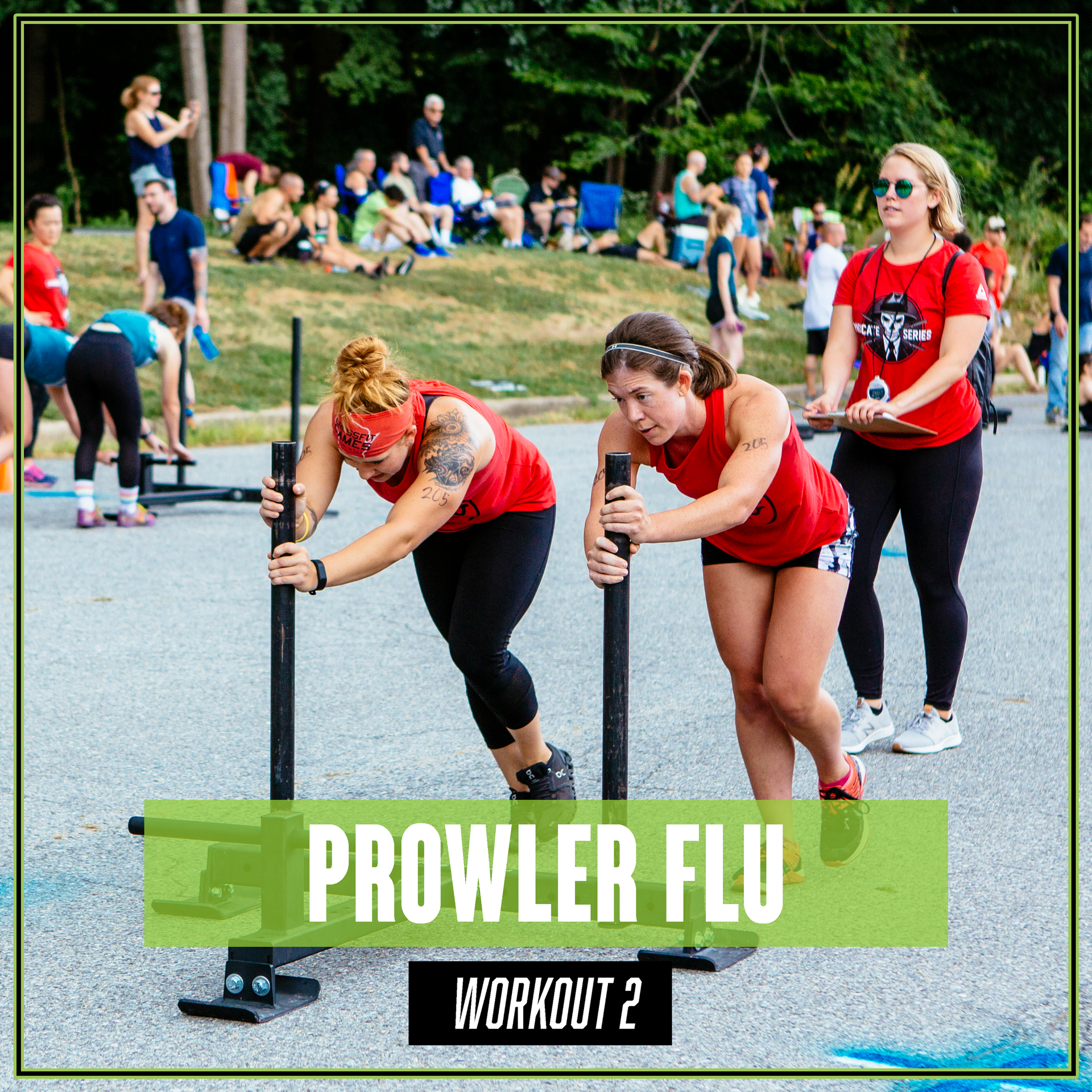

A poster for prowler flu workout 2

WOD 2 - “Prowler Flu”

For time: 

30 meters down (high bar)⁣⁣⁣⁣

30 meters back (low bar)⁣⁣⁣⁣

20 meters down (high bar)⁣⁣⁣⁣

20 meters back (low bar)⁣⁣⁣⁣

10 meters down (high bar)⁣⁣⁣⁣

10 meters back (low bar)⁣⁣⁣⁣

20 meters down (high bar)⁣⁣⁣⁣

20 meters back (low bar)⁣⁣⁣⁣

30 meters down (high bar)⁣⁣⁣⁣

30 meters back (low bar)⁣⁣⁣⁣


High Bar - 1 athlete working at a time

Low Bar - 2 athletes working at a time


Male/Male: (90lbs + sled)

Male/Female (70lbs + sled)

Female/Female (50lbs + sled)


Score

Time

Flow

At the call of 3,2,1...Go! 1 athlete will begin working by pushing the sled on the high bar to the 30 meter mark. Once the sled has achieved the 30 meter mark, both athletes will push the sled on the low bar back down to their starting line. Once both athletes complete the 30 meter low bar push, 1 athlete will return to the high bar to push the sled to the 20 meter mark. Once the 20 meter mark has been crossed, both athletes push the sled on the low bar back to their starting line. After both athletes complete the 20 meter low bar sled push, 1 athlete will push the sled on the high bar 10 meters. When the 10 meter mark has been crossed, both athletes will push the sled on the low bars back to their starting line. This sequence will then repeat itself for 20 meters and finally once again for 30 meters. This workout is for time. 

Movement Standards

High Bar: Only ONE athlete may be working at a time on the high bar sled push. The non-working teammate MUST walk behind the working athlete on the high bar sled push. Athletes may switch out at any time on the high bar, but the sled must be at a complete stop before passing the work off to the other athlete.

Low Bar: For the low bar sled push, both athletes must be working on the sled at the same time. Athletes may switch sides on the sled at any time, but athletes must keep all hands on the low bar while pushing the sled. 
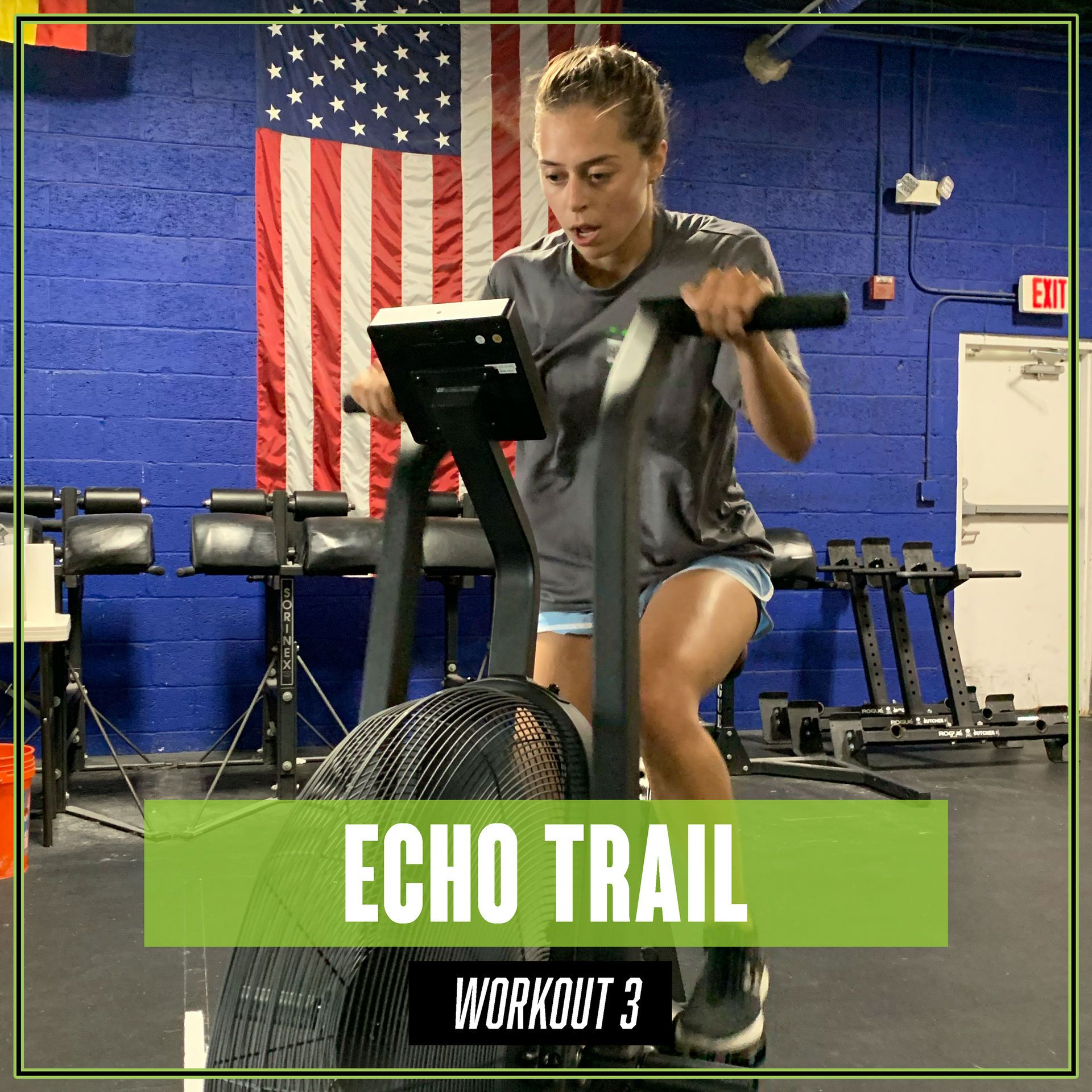

A woman is riding an exercise bike in a gym.

WOD 3 - “Echo Trail”

12 min AMRAP

10-20-30-40…

Synchro DB Front Rack Lunges 

Synchro Single Arm DB Push Press

*Echo Bike cals after each round

Male: 35lbs Dumbbell

Female: 20lbs Dumbbell

Male/Male: 20 Echo Bike calories

Male/Female: 15 Echo Bike calories

Female/Female: 12 Echo Bike calories


Score

The score is rounds and reps.

Flow

At the call of “3,2,1...Go!”, both athletes will perform 10 synchronized DB Front Rack Lunges. This means each athlete will have a pair of dumbbells. Upon completion of 10 synchronized DB Front Rack Lunges, both athletes will then perform 10 synchronized single arm DB Push Presses. Once 10 synchronized single arm DB Push Presses have been completed, the athletes will transition to the Rogue Echo Bike to complete the prescribed cals on the bike, breaking up the work however they choose with only one athlete working on the bike at a time. Upon completion of the calories on the bike, both athletes will transition back to their dumbbells to perform 20 synchronized DB Front Rack Lunges and 20 synchronized single arm DB Push Presses. Once 20 reps of each synchronized movement have been completed, they will then return to the Echo Bike to complete their prescribed cals. This sequence will repeat itself with the synchronized Double DB Front Rack Lunges and synchronized DB Push Press increasing by 10 reps each per round. The required cals on the Bike will remain static. This workout is for time, and the score is rounds and reps. 

Movement Standards

Synchronized DB Front Rack Lunges: Each lunge begins with the dumbbell at the shoulder, feet together, and hips and legs extended. The dumbbell must remain at the shoulder. Athletes must keep both hands on the dumbbells at all times with both dumbbells in the front rack position. The trailing knee must make contact with the ground at the bottom of each lunge before returning to full hip and leg extension. The synchronized portion of this movement occurs at the top of the movement with the knees locked out and the hips open. Once synchronization has been achieved, athletes may begin their next rep. 


Synchronized DB Push Press: Each rep begins with one dumbbell in the front rack position and finishes with the weight fully locked out overhead. Only a dumbbell push press is allowed. Push jerks and split jerks will not be permitted. Athletes will return the dumbbell to the front rack position before releasing the dumbbell to the ground. Weights dropped from overhead will be considered no reps. The synchronized portion occurs at the top of the movement with the weight fully locked out overhead. Once synchronization has been achieved, athletes may begin their next rep.


MORE RECENT POSTS
March 1, 2026
12 Labours Annapolis Liftoff Event Returns – Bigger and Better In July 2023, we hosted our first Liftoff Event in Annapolis. The energy was high, the lifts were heavy, and the competition was fierce. On Saturday, May 2, 2026, the Liftoff returns, and this year it is even better. We have refined the format, clarified divisions, and built an experience designed to challenge athletes at every level while keeping the intensity and excitement that made the first event such a success. Event Details Date: Saturday, May 2, 2026 Session Times: Determined after registration closes on April 11, 2026 - First session begins at 9:00am - Athlete check-in begins 60 to 90 minutes prior to each session Cost: $120 per team Teams and Divisions: 2 Person Teams - Male/Male or Female/Female Novice Division No bodyweight required. Rankings are based purely on total weight lifted. Pro Division Each athlete’s bodyweight will be recorded on competition day and factored into a Sinclair equation to ensure fair and accurate ranking. Event Flow: The Liftoff is built around teamwork, speed, and strength. Phase 1: Olympic Weightlifting Teams lift simultaneously on adjacent platforms. - One athlete performs the snatch - One athlete performs the clean and jerk - Teams have 5 minutes to build to their final lift. The final attempt must be completed before the timer expires. The goal is maximum weight with full technical proficiency. Phase 2: Powerlifting - After the Olympic portion, teams return to the platforms. - One athlete performs a heavy back squat - One athlete performs a heavy deadlift - Again, teams have 5 minutes to reach their final lift. Precision and strength both matter. Scoring Top successful lifts in all four movements are combined: Snatch + Clean and jerk + Back squat + Deadlift Total team poundage determines rankings. The top three teams in both the Male/Male and Female/Female divisions will be awarded. Each platform will have a designated judge to ensure all technical standards are met. A lift only counts when the judge gives the official down command. Registration closes April 11, 2026. Lock in your partner and get ready to lift. If you competed in 2023, you know the energy. If you missed it, this is your chance. The 2026 Liftoff builds on everything we learned and raises the standard.
By Josh Arcona February 23, 2026
If the three core pillars define what we train, these tools define how we train. Each method we use at 12 Labours has been intentionally selected, tested, and refined to support lifelong health while also preparing members for the physical and mental demands of sport, work, and everyday life. Together, they create a balanced system that builds strength, energy, resilience, and confidence — in and out of the gym. 1. CrossFit Functional strength, conditioning, and skill — aligned with intended stimulus. Supports Health for Life: Builds well-rounded fitness in an engaging format Develops balanced, functional movement patterns Makes staying active enjoyable and sustainable Improves confidence in everyday physical tasks Supports Performance & Demanding Lifestyles: Full-body readiness for unpredictable physical challenges Enhances work capacity for athletes and tactical careers Builds resilience under stress Sharpens physical and cognitive coordination 2. Strength Cycles Progressive overload for long-term capability. Supports Health for Life: Builds durable joints, bones, and connective tissues Improves comfort and confidence in everyday movement Supports metabolic health and vitality Supports Performance & Demanding Lifestyles: Enhances power, strength, and resilience Builds the foundation for complex athletic movement Helps withstand heavy or repetitive workloads 3. Resiliency Training Movement quality + injury prevention. Supports Health for Life: Improves posture, movement comfort, and stability Reduces nagging aches and keeps daily movement pain-free Creates safer, more efficient everyday mechanics Supports Performance & Demanding Lifestyles: Enhances durability under load Improves coordination, balance, and joint readiness Supports high-force, high-skill movement demands 4. Endurance Training Energy system development for heart health and sustained effort. Supports Health for Life: Improves heart health and vitality Supports stress management and emotional balance Enhances energy throughout the day Supports Performance & Demanding Lifestyles: Builds stamina for long-duration activities Improves recovery between intense efforts Supports capacity for demanding jobs and outdoor pursuits 5. Mobility Range of motion, joint health, and movement freedom. Supports Health for Life: Reduces stiffness and improves daily comfort Enhances long-term joint health and longevity Improves functional freedom in everyday movement Supports Performance & Demanding Lifestyles: Enhances athletic positions and technical efficiency Reduces risk of strain or overuse injuries Supports complex or high-demand movement patterns SYSTEM SUMMARY – NOW FULLY BALANCED The 12 Labours training system supports: ✔ Those who want to stay healthy, active, and capable for life ✔ Those who train for demanding careers or tactical professions ✔ Athletes and recreational competitors ✔ Outdoor enthusiasts and adventure seekers ✔ Anyone who values being strong, prepared, and confident
By Josh Arcona February 17, 2026
Training is an investment in your life and it deserves to be built on solid principles, not passing trends or quick fixes. That belief has guided how we train, coach, and program from day one. Over more than a decade, we’ve tested, researched, refined, and lived this approach. Through experience on the gym floor, continued education, and real-world results with thousands of members, we’ve identified three core pillars that consistently support long-term health, confidence, and real-world capability. Our approach is built on developing physical strength, improving cardiovascular fitness, and sharpening cognitive fitness. Together, these pillars create a balanced, sustainable system that helps you move better, feel stronger, and stay mentally sharp through every stage of life. Whether your goal is lifelong health, staying active as you age, or being prepared for the physical and mental demands of work, sport, or everyday life, these pillars form the foundation of how we train for life. 1. Strength Strength is the foundation of capability — the ability to live an active, pain-free, confident life. Why Strength Matters For Health: Makes daily tasks easier (lifting kids, carrying groceries, yardwork) Improves posture, reduces aches, and supports joint health Protects bone density and long-term mobility Builds confidence and independence at every age Supports active aging and lifelong physical capability Why Strength Matters For Performance: Enhances power, durability, and force production for athletes Supports physically demanding careers (fire/EMS/police/military/construction) Improves performance in outdoor sports and recreational activities Reduces injury risk under high workloads Builds the ability to perform repeatedly under stress Strength gives everybody — beginners to elite performers — a foundation they can rely on. 2. Cardiovascular Fitness Cardiovascular Fitness improves heart health, energy levels, vitality, and resilience. Why Cardiovascular Fitness Matters For Health: Boosts daily energy and reduces fatigue Supports heart health and long-term longevity Improves mood, sleep, stress management, and emotional balance Helps you stay active without feeling winded Supports healthy aging and metabolic function Why Cardiovascular Fitness Matters For Performance: Increases stamina for sport and high-demand activities Enhances recovery between efforts Supports long shifts and physically intensive jobs Improves resilience during long-duration or repeated efforts Builds the aerobic base needed for endurance-based hobbies At 12 Labours, conditioning is aligned with the intended stimulus — training the right effort for the right purpose. 3. Cognitive Fitness Cognitive Fitness strengthens the mind through skill development, movement learning, focus, and stress regulation. Why Cognitive Fitness Matters For Health: Improves mental clarity and focus Reduces stress, anxiety, and emotional fatigue Supports long-term brain health and aging Creates confidence through mastery and learning Enhances mood and overall wellbeing Why Cognitive Fitness Matters For Performance: Improves reaction time, decision-making, and coordination Enhances performance for sports and tactical professions Builds adaptability and learning capacity Supports staying calm and effective under pressure Cognitive Fitness benefits every human — active, aging, athletic, or anywhere in between. These pillars shape everything we do at 12 Labours. In next week’s newsletter, we’ll dive into the training tools we use, and how each one supports long-term health and real-world capability.
More Posts

you can ACHIEVE your goals with us

CrossFit is meant for all levels of fitness, and our universally scalable model is built for you.